
Bobby Soxers

This story below was written by my mother Patricia Ann Cummings Bergeron during the Spring of 2005. She sent it in to Reminisce magazine that she had subscribed to for years.
Do you remember where you where the day that the Atom Bomb was dropped on Hiroshima ?
When school was let out for the summer of 1945, when I was 16 yrs old. We heard that Bendix Aviation was hiring. Since we lived within walking distance of the factory, across a field, which is now low-income apartment buildings, 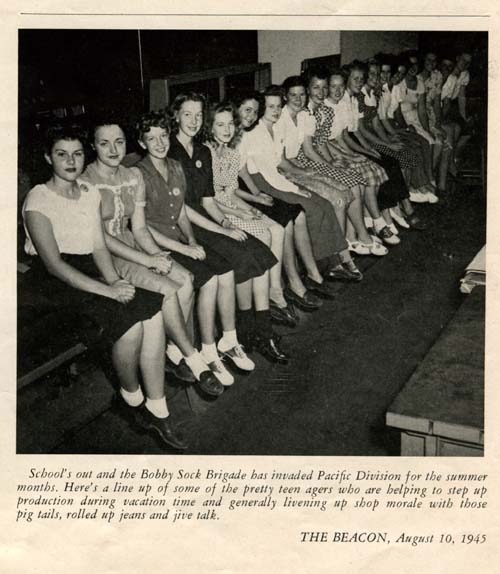 my girl friend Barbara Smith and I hired out on the assembly line. Before the war Bendix was making washing machines and mangles.
The case of the radio was made of bright orange Bakelite. It was about 14 or 15″ high, and about 10 or 12 inches wide, and shaped like an hourglass. The girls on the line called it the “Gibby Girl” because it was shaped like the drawings of girls with hourglass figures that “Charles Dana Gibson” made famous in the early 1900’s.

The department that we were working in was making an S.O.S. radio, called the “Gibson Girl” that was put in the airplanes for the boys to use if their plane crashed or was shot down.
The boys put the radio between their legs (to hold it firmly) and turned the crank that was on the top of the radio.
I was put to work, making a grid of cables, many different colored wires interlaced together, just so. When I was done, the grids were sent over to my friend Barbara’s station, where she soldered all the connection points.
On Monday morning August 6th 1945, when we went to work, we were met at the gate by factory officials, who told us that the factory was closed until further notice.
I remember the picture of the huge mushroom cloud on the front page of that evening’s paper. We learned that an atomic bomb had been dropped on Hiroshima.
 Barbara and I have remained friends all these years.


Footnote
The first life raft rescue radio was a code-sending
transmitter nicknamed the “Gibson Girl”.
Nomenclatures included the BC-778 (SCR-587)
and the AN/CRT-3. At 500 kHz it needed a long antenna,
so it was furnished with both a kite and a balloon to loft
the long wire. A chemical kit made hydrogen to inflate the balloon.


Please add your memories or comment!