
William Prindle ~ First Comeoverer

The name of William Pringle, the emigrant and progenitor of the Prindle family traced in this volume, first appears in America, in the Colonial Records of New Haven, Conn., in 1653-54, where he is referred to as “the Scotchman which lives at Mr. Allerton’s.”
He took the oath of fidelity to the New Haven Jurisdiction, Theophilus Eaton, Governor, on April 4, 1654; married Mary Desborough, December 7, 1656; and, after living for some time in New Haven, bought about 1672, from the administrators of the estate of Sergeant Thos. Jeffreys, 24 acres of land in what is now West Haven, but then really a part of New Haven, and known as “West Farms,” and settled there. This land lies between wha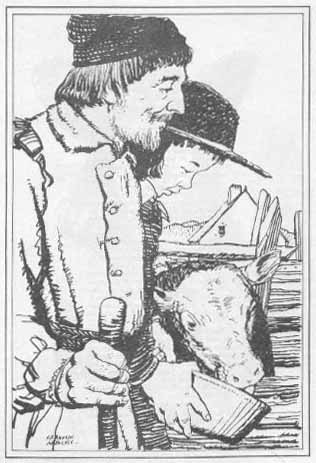 t is now Main and Elm Streets, and Second and Third Avenues, and the old house formerly stood in Second Avenue near Main Street. A part of this land is now owned and occupied by the children of Rollin W. and Lugevia (Prindle) Hine, descendants of the 8th generation, and lies opposite their present home. His name is not found on a list of residents of New Haven, 1640-50.
These brief items tell nearly all that is now known of William Pringle, but much more is needed to satisfy the interest in the progenitor of a family, and we find considerable information of value in the general history of the times and customs of the people where he dwelt.
Isaac Allerton was a passenger on the “Mayflower,” and “was chosen to be an Assistante unto” Gov. Bradford for many years in succession. He was sent several times to England and to Holland to dispose of furs and other products of the Colony and given “full power to conclude the former bargains with ye adventurers.”1 Having been given so much power some cause for dissatisfaction would naturally arise, and about 1632 his connection with the Plymouth Colony was severed, though he was not until several years after a settler of New Haven.
The New Haven Colony arrived at New Haven in the spring of 1638, having passed the winter in Boston, and was composed principally of members of the church and congregation of which the Rev. John Davenport was pastor, in Coleman Street, London. They came provided with means and “men skilled in various arts,” and Cotton Mather writes ‘The Colony was under the conduct of as holy, and as prudent, and as genteel persons as most that ever visited these nooks of America.”
Mr. Allerton came to New Haven to stay about 1646, and built a handsome house “all of oak and the best of joiner work,” having four porches and equal in every respect to that of the Governor. The intervening years were probably spent in New York where he continued his trading, though the final settlement of his affairs with the Plymouth Colony dragged along for several years.
He was married three times, his first wife being Mary, the daughter of Elder Brewster, whose account of Mr. Allerton’s relations to the Plymouth Colony is quaint and interesting, and gives us an idea of the man and his character, although he is mentioned only at long intervals in the Elder’s diary.
“Besides, through private gaine, I doe persuade my selfe, was some cause to lead Mr. Allerton aside in thse beginnings, yet I thinke, or at least charitie caries me to hope, that he intended to deale faithfully with them in ye maine, and had such an opinion of his own abilitie, and some experience . . . as he conceived he might both raise himselfe an estate, and allso be a means to bring in such profits to Mr. Sherley. … At length, they, having an opportunitie, resolved to send Mr. Winslow, with what beaver they had already, into England, to see how ye square wente, being very jealouse of these things, and Mr. Allerton’s courses.”
Mr. Sherley writes also,
“I fear neither you nor we have been well delte withal . . . and yet for all this … I dare not but thinke him honest, and that his desire and intente was good.”
In the Chronicles of New Haven Green, it is stated that,
“On the lower Green, in some place unknown, but supposed to be not far from the flagstaff, lies Isaac Allerton, one of the Mayflower Pilgrims, and ‘father of American Commerce’.”
This is the man under whose roof our William Pringle found a home, but for how long a time we do not know. The town records of New Haven make some interesting references to him, which gives us some idea of the man he was, as will be seen by the following extracts:
“Feb. 27, 1653. — -The townsman were desired and appointed to speak with the Scotchman which lives at Mr. Allerton’s, and see if they can agree with him to sweep the chimneys in the town according to the order made 13th of November, 1643.”
“Jan. 28, 1655. — It was propounded that one might be gotten to sweep chimneys in the town. William Pringle was named, and some were desired to speak to him to come to the governor and speak with him about it.”
“Feb. 11, 1655. — The governor further acquainted the town that William Pringle, who was spoke of to the last court to sweep chimneys for the town, had been with him, and propounded some difficulty in the work, but the manner of paying discouraged him much, but hoping that may be amended, he is willing to try another year, if the town will lend him 40 shillings in corn, and let him have a canvas frock, and hood, to cover his clothes when doth the work. But now, Peter Mallory, from him declared, that the 40 shillings to be lent, he let it fall, so he may have the frock propounded, and his pay for his work duly paid him. The town declared if canvas can be got, he shall have such a frock and hood, he promising that if he leave the work, to leave such garment to the town again, and that men pay him down for his labor, or otherwise to his content, but if not, upon complaint the court will see it remedied, and that all chimneys in the town be included, and none exempted from pay, though they sweep them themselves, provided that he come within such time Winter and Summer, as is expressed in an order in the town records.”
“The 4th of the 10th month, 1656.- — The townsmen are desired to treat with William Pringle and agree with him to sweep chimneys for the town as they see cause.”
The inhabitants were obliged to have their chimneys swept twice a year, or be fined. The doer of the task was not looked down upon by the others, for there were many things essential to the welfare of such a community that were not particularly agreeable, but persons to perform such duties were appointed by the town meeting and regarded as a call to duty for the common welfare. Many of the early chimneys were built of logs and plastered with clay on the inner surface, and it was, therefore, a matter of self-protection to appoint and maintain the office of Chimney sweep. But it was sometimes difficult to get and keep one in the office, largely, no doubt, because “the manner of paying discouraged them much,” for in 1658 “the townsmen informed the Court that they could prevail upon no man to be chimney sweeper.” William’s independent way of “treating with the townsmen” indicates his standing in the community.
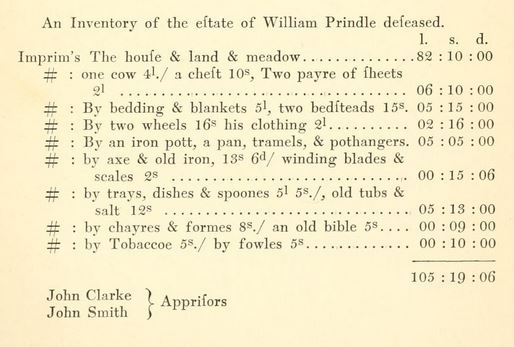
After these records William’s name appears in the transfer of property, and in the birth records of his children, etc. His will, dated October 17, 1689, and probated June 5, 1690, with inventory of his estate, also appear; but the exact date of his death is not now known.
William and Mary were in all probability buried in the ancient ground of New Haven Green, which was used as a place of burial from 1638 to 1812.
The part of this ground so used was that around and under the present Center Church, in the crypt of which are still preserved many headstones of the early settlers. When the Green was leveled in 1820 the stones that were in good condition were taken to the then new Grove Street Cemetery and placed against the stone fence, but none can be found there of William or Mary.
The vestry records of Christ Church date back as far as known only to 1778, while those of Trinity Church date back only a few years earlier, to 1767, and contain the names of many Prindles, including those of Joseph, at which time the Prindles of New Haven were, and ever since have been, stanch Episcopalians.
It is not known to what denomination William belonged, but in the assignment of seats in the old “meeting house,” by order of the general court, Feb. 20, 1661-2, the name of William Pringle appears, with others, on the list of those seated “Below the door,” and Mrs. Isaac Allerton is assigned a seat, with other women, “In the short seats at the upper end,” Mr. Allerton having died in 1659. It is probable that William may have had a sitting in the meeting house before this time, as the last order of the court before this, assigning the seats, was dated 4 yrs. before and then the names of both Mr. and Mrs. Allerton appear.
Besides the name of William Pringle in 1653, on the New Haven records, we have a John Pringle, “after-planter,” in l645, on the Milford records; but thus far nothing further has been learned about him, nor of his relationship, if any, to William. He might easily have been an older brother, perhaps bringing William with him as a lad, for William does not take the oath of allegiance until 1654. Or perhaps William may have followed John a little later; possibly one or both “were adventurers” in a company brought over by Mr. Allerton. About these things, however, we can only conjecture. Of the traditions that come from more or less widely separated branches of the family, nearly all agree that there were “brothers” who came to this country, but differ as to the number, whether two or three, though all agree that one settled in Connecticut.
There were Prindles and Pringles in several of the colonies, but they were probably later emigrations from England and Scotland. In the old country they were most numerous in the border counties of Northumberland in England, and Roxburgh in Scotland, the earliest records of Pringles being found at the latter place.
William Pringle’s Will
Probated June 5, 1690.
New Haven Probate Records.
Vol. II, pp 38-39.
Wm. Pringle.
The last Will & Teftament of William Prindle: Imprimis, when it shall pleafe god to take me out of this world, I doe bequeath my foule to the lord, & my body to a decent buriall; And as for my goods & effects I doe bequeath unto my loveing wife & my son Eleazer Prindle, and when it shall pleafe god to take away my wife by death, Then doe I will the whole of my eftate unto my aforefd fon Eleazer Prindle to be his forever; only further, for the comfortable fubsiltence of my wife, I doe will that fhe fhall have command of the houfe & what is within ye houfe dureing her life, & at her deceafe, then my fon Eleazer Prindle as aforefd fhall receive ye whole of my eftate, he paying all my debts & Legacyes & the Legacyes are to my children that are here mentioned : Unto John Prindle twenty fhillings./ Unto Ebenezer Prindle twenty fhillings./ Unto Sam Prindle twenty fhillings Unto Mary Roach twenty fhillings. — Unto Hannah Prindle twenty fhillings Unto my daughter Beecher five fhillings & unto Joseph Prindle five fhillings. And furthermore my aforefd son Eleazer whom I have made my executor”, doth engage to maintaine me and my wife as long as we shall live comfortably: And upon thefe confiderations, I doe as above fd Will will unto my aforefd fon Eleazer Prindle, all & the whole of my eftate, goods, cattle, chattels, my houfe, orchard, upland & meadow, to be his & his heyrs forever; peaceably & quietly to poffefs the whole of my eftate, without any hindrance, lett or moleftation, from any perfon or perfons to enjoy forever: This I doe own as my last Will & Testament as wittnefs my hand this feventeenth of October one thoufand fix hundred eighty nine./
The marke of X William Prindle.
Teftes
William Trowbridge
John Umfrevile
This article is Note 1 of the Appendix in The Prindle Genealogy: Prindle, Franklin C. b. 1841. (1906). The Prindle genealogy: embracing the descendants of William Pringle the first settler, in part for six, seven and eight generations, and also the ancestors and descendants of Zalmon Prindle for ten generations, covering a period of two hundred and fifty-two years, 1654-1906. New York: The Grafton press.
- “The Adventures” were the British Merchants who financed the Mayflower’s voyage, the Pilgrims were in debt to them for years ↩

Please add your memories or comment!